Whitney Webb and Mark Goodwin Called the Synthetic CBDC in 2023
In December 2023, investigative journalists Whitney Webb and Mark Goodwin argued the US digital dollar would not arrive as a Fed CBDC but as privately-issued, surveillable stablecoins. A year and a half later, the GENIUS Act codified exactly that. Here's the conversation that called it.

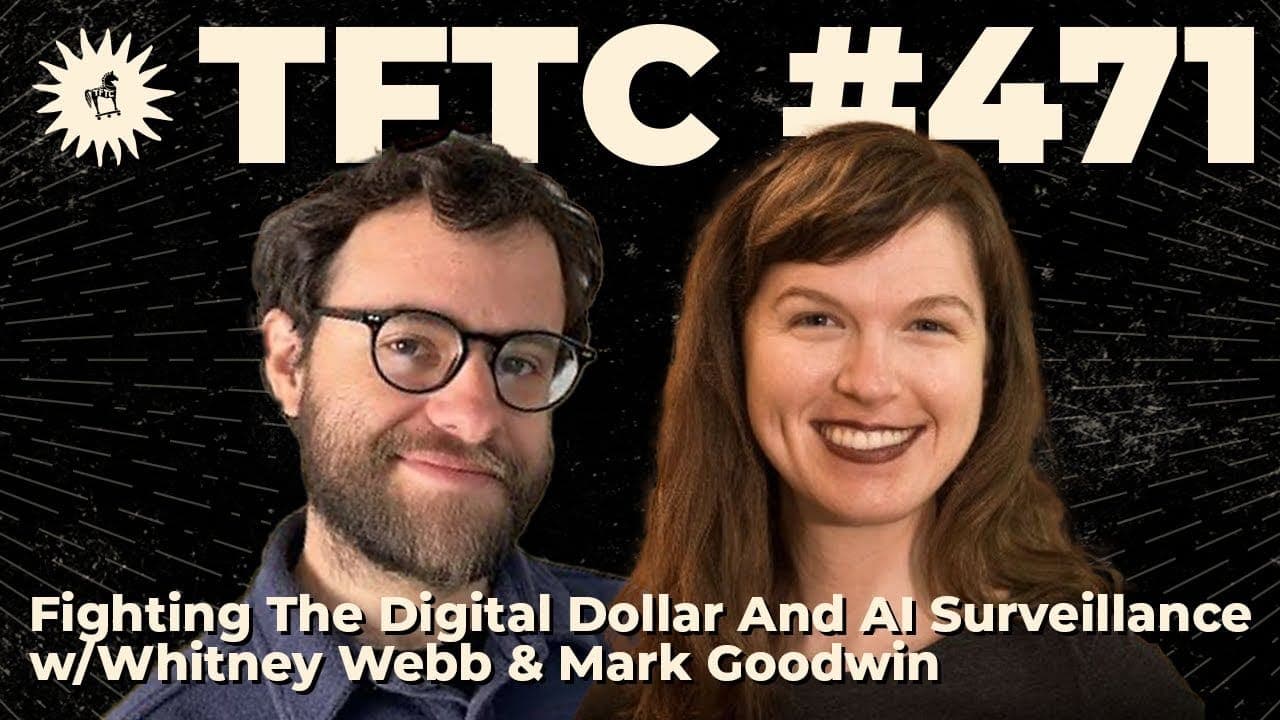
Guest: Whitney Webb
↓ Jump to the video and timestamps
This conversation with investigative journalists Whitney Webb and Mark Goodwin was recorded in December 2023. I'm flagging the date up front because it's the point. Roughly a year and a half before the GENIUS Act became law, and a year before the executive order banning a US central bank digital currency, Webb and Goodwin sat down and described, in detail, the system that both of those policies would go on to build: a digital dollar that arrives not as a Fed-issued CBDC but as privately-issued, fully-surveillable stablecoins that do everything a CBDC was feared for.
The occasion was a piece they had just co-written for Unlimited Hangout, Unmasking Farmington: FTX, Fluent Finance and the Coming Digital Dollar, tracing a thread from a tiny rural bank to a stablecoin company almost nobody had heard of. At the time it sounded like a forecast. Reading it back now, it's a description. The "no CBDC for America" political victory arrived on schedule, and so did its replacement.
I documented how that played out in a full piece on how the digital dollar arrived without a CBDC. This episode is where the thesis was laid out first. Webb stated the core of it in one sentence that the next eighteen months would prove:
"A bank-issued stablecoin is still just as surveillable and programmable as a hypothetical CBDC would be."
Key takeaways
- The digital dollar wouldn't come from the Fed. Webb and Goodwin's central argument: the government doesn't want the constitutional friction or the deposit flight of a retail CBDC, so it lets private issuers build the surveillable digital dollar while keeping the power to blacklist and freeze.
- A private stablecoin does everything a CBDC does. The corporate logo doesn't change the control surface. Programmability and surveillance are the point, and a regulated bank-issued stablecoin delivers both.
- Tether is a "narrow bank," and the banks hate that. Because Tether holds its reserves one-to-one, you can't run fractional-reserve banking on it. Goodwin's read is that the commercial banks need a synthetic deposit token they can rehypothecate to rebuild the system they actually profit from.
- Stablecoins are a Treasury-demand machine. Issuers park reserves in US debt, which turns the "digital dollar" into one of the hungriest buyers of Treasuries on earth and gives Washington every reason to usher it in.
- The Farmington/Fluent affair looked like a dry run. A century-old single-branch bank swelling with FTX-linked deposits, getting Fed approval it should never have received, then partnering with an obscure stablecoin company days before FTX collapsed.
- Don't let Bitcoin become the rail for it. Their warning to bitcoiners is what Goodwin calls orange-washing. The defense is privacy-preserving ecash, not tokenized surveillance dollars riding on the base layer.
The dot they connected: Farmington, Moonstone, and Fluent
The conversation opens on the story their article reconstructs, and the details are what make it land. Farmington State Bank was a more-than-century-old, single-branch bank in rural Washington state, what Webb calls a "broom closet sized" bank that had never held much more than $10 million in deposits. Then it came under the control of the Deltec crowd, the offshore bank chaired by Jean Chalopin that serves both FTX and Tether, with figures like Noah Perlman, now Binance's chief compliance officer and a former Gemini executive, connected to the acquisition vehicle. Within about a year, by Webb and Goodwin's account, deposits swelled from roughly $10 million to $84 million. Around $71 million of that sat in four accounts, $50 million came from a single account tied to FTX Digital Markets, and Alameda Research poured in another $11.5 million. The bank rebranded as Moonstone and presented itself as a crypto-focused bank, and it secured Federal Reserve approval that, in their reading, it never should have gotten. This isn't only their characterization: the Fed's own August 2023 enforcement action found that Farmington had changed its business plan without the required approval and had arranged to issue stablecoins in exchange for 50 percent of the mint-and-burn fees, then forced the bank to wind down without ever explaining how it was approved in the first place.
The new thread their piece adds is Fluent Finance. Just before the collapse, Farmington/Moonstone partnered with Fluent, a company built around a dollar-pegged stablecoin called US Plus, which Fluent itself describes as "bank-led" and "forward-compatible with CBDC initiatives." That phrase alone, from the issuer's own marketing, is the synthetic-CBDC thesis stated out loud. The timing is the tell: it came within days of an October 2023 interview in which Sam Bankman-Fried said FTX was looking for the right partner to launch a stablecoin. Webb's point is that if FTX hadn't blown up, this would have been announced as the FTX stablecoin. Fluent's founders sharpen it further. The lead figure, Bradley Allgood, came out of NATO and military-intelligence work before setting up special economic zones to rival Delaware, and his co-founder Oliver Gale worked on an early Barbados CBDC and has described himself as an inventor of the central-bank-digital-currency concept. Allgood, Webb notes, has openly written that CBDCs would be great if Wall Street were put in charge.
Why private, on purpose
The spine of the argument is about who issues the digital dollar, and why that choice is deliberate. A retail CBDC, a direct Federal Reserve account for every citizen, runs into constitutional problems and would pull deposits out of the commercial banks. So the path of least resistance is to let private companies issue the digital dollar while the government keeps the levers that matter: the ability to surveil it, blacklist it, and freeze it.
Webb's strongest historical analogy is Total Information Awareness, the post-9/11 mass-surveillance program that drew so much public backlash it was formally killed, then quietly re-emerged through private-sector vehicles like Palantir. The lesson the national security state took, in her telling, is that the public will reject a surveillance system if the government is overtly running it, but will accept the same system if it appears to be a private venture. CBDCs, she argues, are following the identical script. People rejected a government-issued, government-programmed digital dollar, so the issuers become JPMorgan and the regulated stablecoin companies instead. What the government gives up by not issuing the money directly, it gets back by not having to clear the legal bar a government currency would face. The fear of a CBDC was never about whose name is on the money. It was about programmability and surveillance, and a regulated private stablecoin delivers both.
The narrow-bank problem
Goodwin adds the piece that most stablecoin coverage misses. Tether, for all the "Tether truther" suspicion, is structurally a narrow bank: it holds reserves close to one-to-one, largely in Treasuries custodied at Cantor Fitzgerald. The problem, from the banks' perspective, is that you cannot run fractional-reserve banking on a one-to-one model. The commercial banks have no intention of giving up the fractional-reserve machine that is their actual business. So the move, Goodwin argues, is to create a synthetic deposit security token that can be rehypothecated, recreating fractional-reserve banking inside the new tokenized system. That, in his framing, is why Jamie Dimon could sit beside Elizabeth Warren talking about banning crypto while JPMorgan built its own deposit token. The banks don't want Tether and Paolo Ardoino issuing the dollar. They want to issue it themselves.
The Treasury-demand engine
The second reason Washington would actively want this is the balance sheet. Stablecoin issuers back their tokens with reserves, and the reserve of choice is US Treasuries, which makes a widely-adopted dollar stablecoin one of the largest new buyers of government debt in the world. Goodwin noted that Tether, if it were a country, would already rank among the top twenty holders of US debt. Set that against a federal debt then past $33 trillion and a debt-service problem with no arithmetic solution, and the policy momentum becomes obvious: the "innovation" and the deficit financing point in the same direction.
The freeze function is not theoretical either. Goodwin recounted Cantor CEO Howard Lutnick's own public description of how it works: if the government wants something frozen on Tether, you call Tether; on Ethereum you call Joe Lubin; on Bitcoin, you can't call anyone. That single contrast is the whole reason this matters. The tokenized dollar is being built precisely because it has an off switch, and Bitcoin's lack of one is what they're working around.
R3, Corda, and the bridge between two CBDC worlds
The part that surprised me most was R3. I had assumed the enterprise-blockchain company faded into irrelevance after its 2015-era hype cycle. Webb's reporting says the opposite. R3 was named Central Banking's CBDC Partner for its Corda ledger, is backed by some of the largest banks in the world including Citi, HSBC, and Barclays, and runs a "Digital Currency Accelerator" that lets banks and central banks sandbox programmable money. Its Corda ledger is partnered with the DTCC on the securities side and is building the UAE's central bank digital currency. Webb's claim is that Fluent Finance, after Moonstone shut down, set up in the UAE precisely to be the connective tissue between the direct-issue CBDCs of the BRICS world and the synthetic CBDCs and deposit tokens of the West, with interoperability overseen by the Bank for International Settlements. Her larger point cuts against the usual framing: the threat isn't only the BIS or only the BRICS. Wall Street has its own plan, under a different name, and almost no one is watching it.
The crisis that sells it
Webb and Goodwin's framework for how all of this gets adopted is older than crypto: manufacture the crisis, harvest the reaction, sell the pre-built solution. Their specific concern is a cyberattack on the financial system. Webb pointed to the WEF-convened exercises and a Carnegie Endowment working group, gaming out exactly that scenario, and to the fact that the big banks share a unified response plan through their information-sharing center. The worry is that a banking or cyber shock produces the public demand for safety, and a surveilled digital dollar plus a digital ID to attach every transaction to a person get presented as the rescue.
The tell, in their account, is the moment privacy gets reframed from a right into a red flag. When the system needs everyone onboarded, the people who want to transact privately become the suspicious ones. And the political "victory" of banning a US CBDC is, in their reading, the setup for the swap. As Webb put it, the same programmability and surveillability simply move into the synthetic CBDC, so "no CBDC for America" becomes a false win that lets the surveillance dollar arrive wearing a corporate logo. You don't have to accept every part of their wider worldview to see that this specific prediction is exactly what happened.
The orange-washing trap, and the real defense
The conversation does not end in fatalism, but it ends with a warning aimed at bitcoiners. Goodwin's term is orange-washing: the assumption that because Bitcoin is freedom money, anything built on top of it inherits that freedom. It doesn't. The same base layer that secures self-custodied Bitcoin can also carry tokenized debt and surveilled stablecoins if that's what gets built on it. He was blunt about the people manufacturing consent for it, including the pitch that stablecoins on Lightning would bring trillions into Bitcoin and that fighting it makes you a martyr.
"Lightning Labs, this Taproot Assets line, is 'let's bitcoinize the dollar.' And it's like, no, you're dollarizing Bitcoin. I know what you're doing."
The real defense they point to is privacy-preserving digital cash. Goodwin's own framing is that you can build a stable unit of account using ecash or Lightning channels that never touch Treasuries at all, and Marty's addition was that Chaumian mints are the killer app for this. The point isn't to recreate the dollar on Bitcoin. It's to keep the open base layer from becoming the settlement rail for the surveillance dollar, and to give people a way to transact privately that doesn't route through it. That defense is the subject of our later conversation with Calle.
More on the surveillance dollar
Webb and Goodwin sketched the blueprint in 2023. The full account of how it was built, through the January 2025 executive order banning a CBDC, the GENIUS Act's freeze-and-block requirements, and Tether's documented multi-billion-dollar freezes, is the receipt on this conversation. Read together, the episode is the prediction and that piece is the confirmation.
Frequently Asked Questions
Why does it matter that this conversation happened in December 2023 specifically?
What made Farmington State Bank worth investigating in the first place?
What does "orange-washing" actually mean in practice?
How does the Treasury-demand angle connect Washington's financial interests to stablecoin adoption?
What is R3's Corda, and why does it matter to this story?
What is the actual alternative to stablecoins for people who want a stable unit of account without the surveillance?
How does the Total Information Awareness comparison help explain the stablecoin rollout?
About Whitney Webb and Mark Goodwin
Whitney Webb is an investigative journalist and the author of One Nation Under Blackmail. Mark Goodwin is her co-author at Unlimited Hangout and the author of The Bitcoin Dollar, a study of how the dollar system, Treasuries, and stablecoins interact. The two have written extensively on stablecoins, the "Bitcoin Dollar," and the synthetic-CBDC thesis.
Sources mentioned
- Unmasking Farmington: FTX, Fluent Finance and the Coming Digital Dollar: the Webb/Goodwin investigation this episode is built on
- Federal Reserve enforcement action against Farmington State Bank: the Fed's own August 2023 order, including the stablecoin mint-and-burn arrangement
- Central Banking: R3 named CBDC Partner: the award and the central-bank client list
- The digital dollar, explained: how the synthetic CBDC was built, 2025
- Calle on the ecash defense: the privacy-preserving alternative
Watch the conversation
Timestamps
- 0:00 - Intro
- 2:38 - Exposition on Farmington and Fluent Finance
- 9:08 - Stablecoins
- 17:39 - Transitioning to CBDC
- 31:52 - Crisis as pretense for surveillance and war
- 50:20 - Digital ID
- 1:00:23 - Powell's not your pal
- 1:03:59 - Figuring out the de facto CBDC
- 1:10:02 - Manufactured consent psyops
- 1:25:17 - Social media warzone
- 1:33:26 - Preventing Bitcoin co-opting
- 1:45:35 - They'll profile and surveil everyone
- 2:21:59 - Building alternatives
- 2:31:12 - Wrapping up
Sponsors
- River: buy Bitcoin and take self-custody, best-in-industry fees, zero-fee recurring buys. river.com/tftc, get $5 in Bitcoin after you buy $100.
- CrowdHealth: crowdfunded healthcare, not insurance, with Bitcoin Lightning payments. joincrowdhealth.com/tftc, $50 off your first month.