US Ports Face Thousands of Daily Cyberattacks as Crude Export Node Goes Undefended
The Port of Corpus Christi is absorbing hundreds to thousands of cyberattack attempts per day. It moves 60% of US crude exports. It has three cybersecurity employees. Washington's fix is a plan due in 2027.
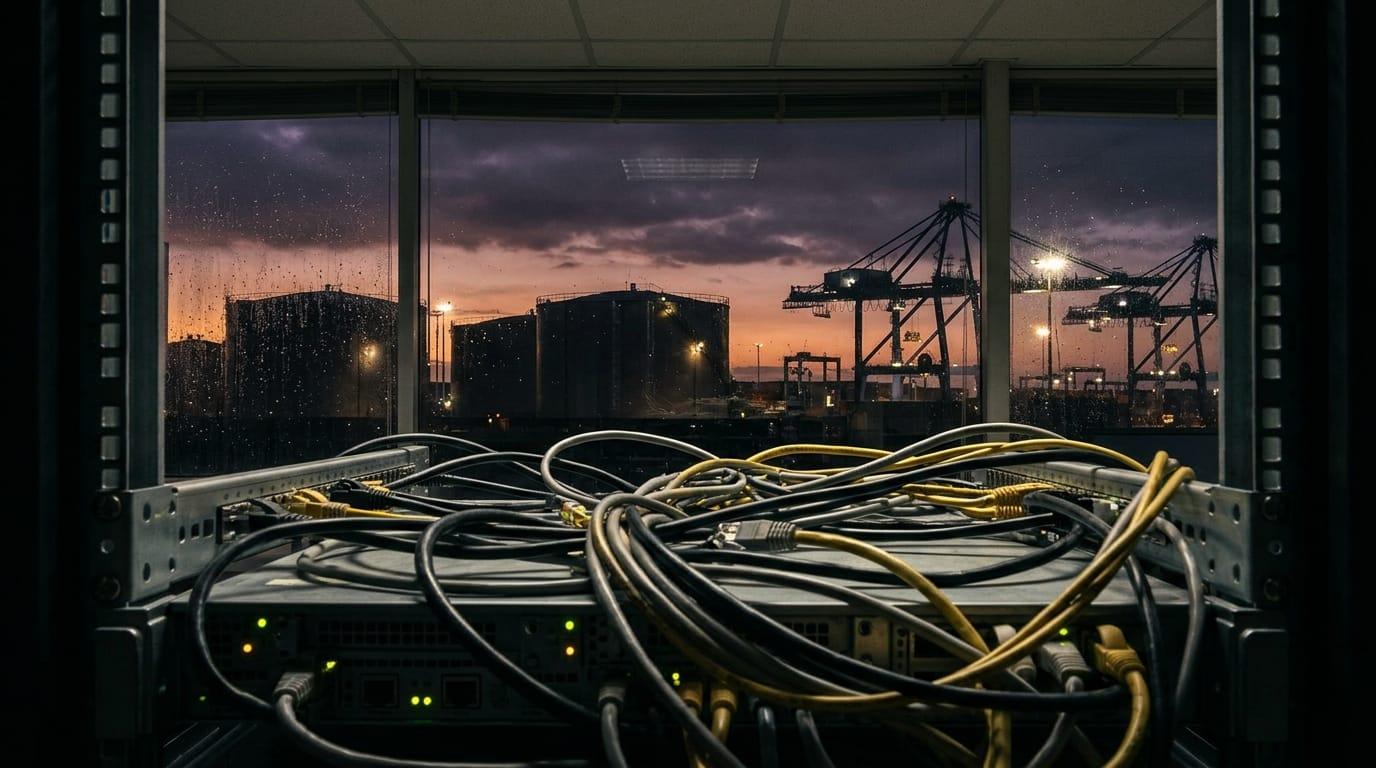
The port moving most of America's oil is absorbing hundreds to thousands of intrusion attempts per day. The government's answer is a compliance form due in 2027.
Key takeaways
- The Port of Corpus Christi, which handles roughly 60% of US crude exports (approximately 2.3 million barrels per day), is fending off "hundreds or even thousands" of cyberattack attempts daily, per CEO Kent Britton as first reported by the Financial Times.
- The Port of Los Angeles blocked more than 120 million attack attempts in August 2026 alone, nearly double its 2023 monthly average, as foreign-flagged tankers in the Gulf of Mexico were boarded by the Coast Guard and FBI after confirmed network compromises.
- The Coast Guard's new mandatory cybersecurity rule took effect July 2025, but ports do not have to submit cybersecurity plans for approval until July 16, 2027, leaving the most critical US crude export infrastructure on a voluntary defense posture for another 20 months.
Port of Corpus Christi CEO Kent Britton told the Financial Times on November 22 that hackers are running "hundreds or even thousands" of intrusion attempts against port systems every day, combining vulnerability probing with executive-impersonation phishing. The port moves approximately 60% of US crude exports, roughly 2.3 million barrels per day. "They're poking at our systems and trying to find vulnerabilities," Britton said. "With AI, it'll only get more complicated."
The Port of Los Angeles reported blocking more than 120 million cyberattack attempts in August 2026 alone, covering intrusion attempts, credential harvesting, and malware deployment. Executive Director Gene Seroka framed the asymmetry plainly: "All they have to do is to get it right one time." The Coast Guard and FBI boarded two foreign-flagged tankers in the Gulf of Mexico on August 21 and August 24 after indications that both vessels' networks had been compromised by foreign cyber actors, according to a joint FBI and Coast Guard statement. The Coast Guard attributed the incidents to "foreign cyber actors" without naming a specific state actor.
A 20-Month Window the Attackers Will Use
Washington's primary response is 33 CFR Part 101, Subpart F, the Coast Guard's maritime cybersecurity rule that took effect July 16, 2025, for US-flagged vessels and port facilities. The rule is real. The problem is the timeline: ports and terminals do not have to submit their cybersecurity plans for Coast Guard approval until July 16, 2027. That is 20 months from now.
Corpus Christi is currently staffed with three cybersecurity employees and is in the process of hiring a fourth, per the Financial Times. That is the defensive posture, in real time, for the node handling the majority of US crude exports.
A GAO audit of Coast Guard maritime cybersecurity (GAO-25-107244) documented the gaps in the existing framework before this escalation. The auditors' concerns are now being tested live.
Dryad Global CEO Corey Ranslem was direct after the tanker boardings: "We are expecting these types of attacks to continue" and they "will expand in the very near future." Britton put the defender's problem in equally clear terms: "If you're playing defence, you have to get it right every time. If you're playing offence, you only have to get it right once."
The Concentration Risk Is Monetary, Not Just Physical
Corpus Christi is a petrodollar vulnerability as much as a port vulnerability. The US dollar's global reserve status is partially underwritten by oil priced and settled in dollars. A successful disruption to that throughput does not just spike WTI prices. It rattles the settlement architecture that makes the dollar the world's pricing currency.
The Coast Guard's attribution to "foreign cyber actors," combined with the tanker incidents in the Gulf of Mexico, connects directly to the broader energy security picture. When the pipes for physical energy are under sustained attack, the question of whether the pipes for financial value should be equally centralized and equally attackable becomes concrete, not theoretical.
The Russian crude sanctions picture already shows how fragile the consensus around petrodollar enforcement has become. Add an adversary-driven capability to disrupt physical crude throughput at the dominant US export terminal, and the system's single points of failure stack.
What to Watch
The falsifiable version of the concern here: if the Coast Guard's cybersecurity framework, including the mandatory plan submissions due July 2027 and Coast Guard Cyber Protection Teams, demonstrably reduces incident frequency and severity before a successful disruptive attack materializes, the centralized compliance model is working. Watch for the inverse: a successful port operational shutdown, a crude export halt traceable to a cyber event, or evidence that the 2027 deadline gets extended again. Any one of those confirms that the attack timeline and the compliance timeline are not in the same universe.
Sources
- Coast Guard Cybersecurity Final Rule, 90 FR 6298 (Federal Register)
- Coast Guard official article on the cybersecurity rule
- GAO Report GAO-25-107244: Coast Guard Maritime Cybersecurity
- First reported by the Financial Times, November 22, 2026
Frequently Asked Questions
What does the Coast Guard's new maritime cybersecurity rule actually require right now?
The rule (33 CFR Part 101, Subpart F, effective July 16, 2025) requires US-flagged vessels and port facilities to designate a cybersecurity officer, report cyber incidents to the Coast Guard, and implement certain baseline controls. The critical gap: cybersecurity plans do not have to be formally submitted to the Coast Guard for approval until July 16, 2027. Until then, the specific defensive measures a given port has in place are largely self-determined and not subject to external review.
Could a successful cyberattack on Corpus Christi actually halt crude exports?
Port operations depend on interconnected systems: vessel scheduling, loading terminal controls, SCADA systems managing pipeline flow, and electronic gate processing. A sophisticated intrusion that compromises any of those layers could force a shift to manual operations (as happened at North Carolina's ports in August, when a cyberattack forced all three state port facilities onto manual gate processing) or take loading systems offline entirely. At a facility moving 2.3 million barrels per day, even a partial operational shutdown would register immediately in US export data and global crude markets.
Who is behind the attacks on US ports?
The Coast Guard attributed the August tanker boardings to "foreign cyber actors" without publicly naming a state sponsor. The pattern of targeting, concentrated on crude export infrastructure and commercial vessels, is consistent with state-directed or state-tolerated activity. Attribution in maritime cyber incidents typically takes months and is often never made public.