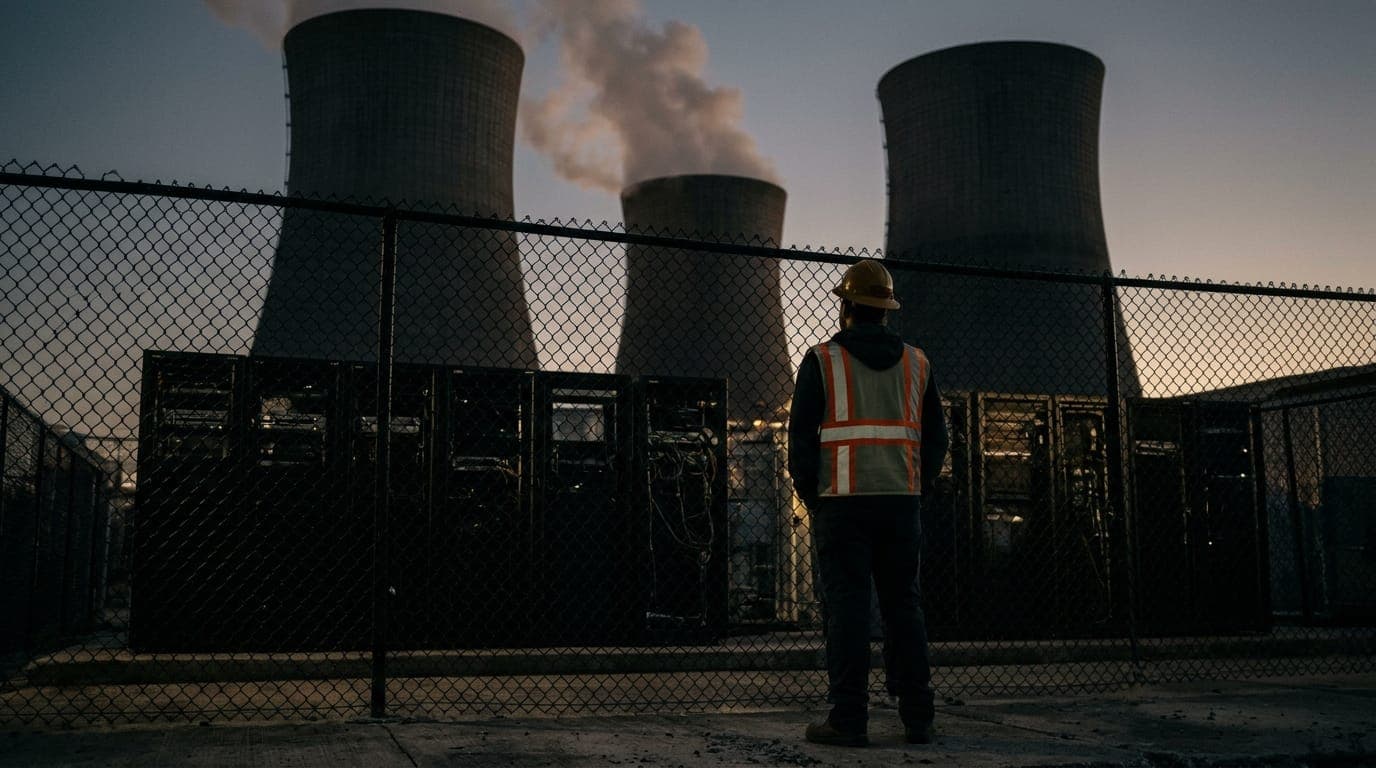
Stargate's 7-Gigawatt AI Buildout Is Repricing Power Beneath Bitcoin Miners
Stargate's $500B AI infrastructure push has locked in nearly 7 gigawatts of planned U.S. capacity across six campuses. The grid math is already hurting Bitcoin miners.
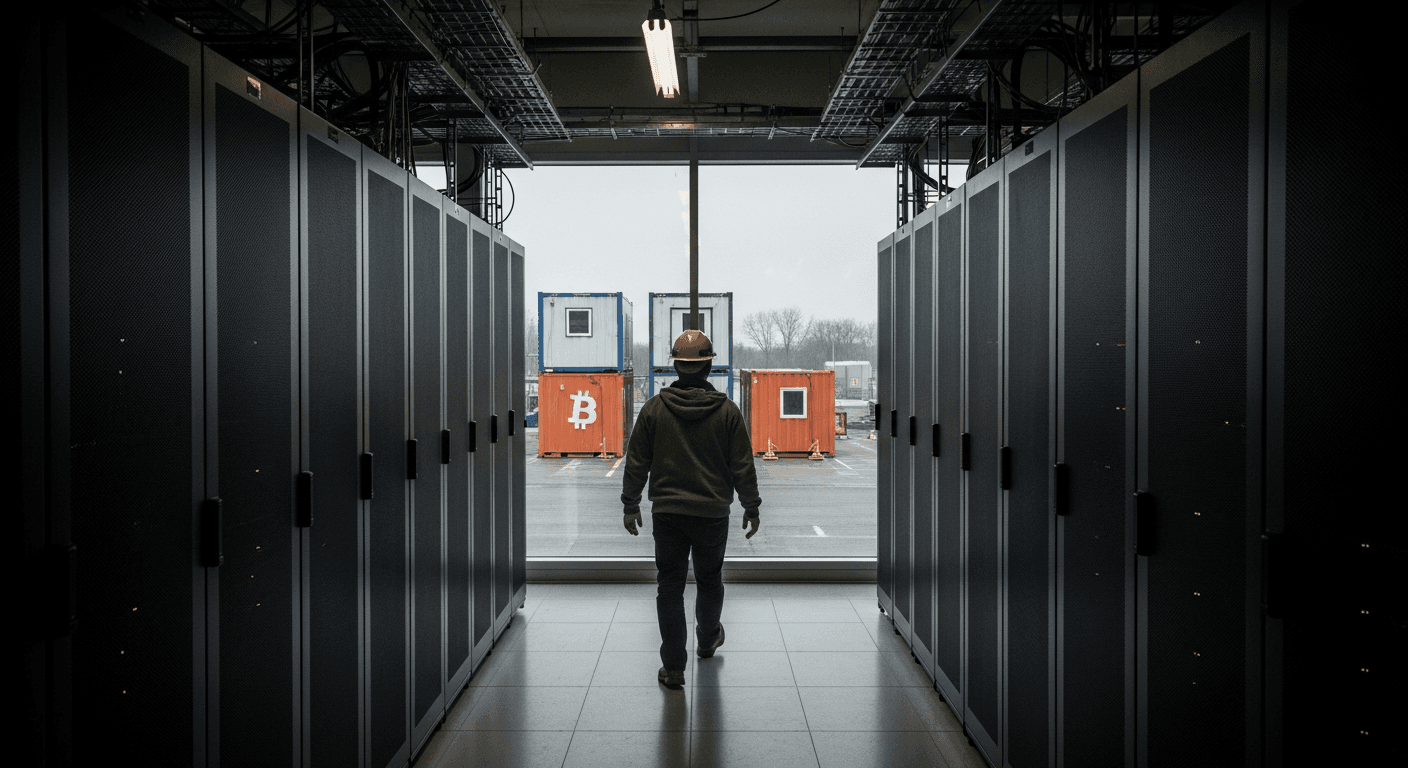
OpenAI, SoftBank, and Oracle are ahead of schedule on a $500B compute land grab, and the grid math is already compressing Bitcoin mining margins.
Key takeaways
- Stargate LLC now has nearly 7 gigawatts of planned U.S. capacity across six campuses and over $400 billion in committed investment, putting the project ahead of its original 10 GW, $500 billion target.
- ERCOT large-load power requests jumped to more than 225 gigawatts in 2025; AI and data center companies now account for more than 70% of new large-load applications in Texas, and energy prices in key mining regions rose 15-20% last year, structurally squeezing Bitcoin miners who cannot match AI's revenue per kilowatt-hour.
- Three incumbents are consolidating control of frontier compute under government sanction, the full $500B is not yet committed, construction delays are real, and the grid bottlenecks those delays create have direct consequences for every energy-intensive industry sharing the same infrastructure.
OpenAI, SoftBank, and Oracle announced five new U.S. Stargate data center sites in September 2025, bringing the joint venture's total planned capacity to nearly 7 gigawatts and committed investment to over $400 billion, per the OpenAI blog. Oracle broke ground on a sixth site in Saline Township, Michigan on June 2, 2026, per CNBC. The project, formally announced January 21, 2025 at the White House, was originally structured around a $500 billion, 10-gigawatt target by 2029. As of the September 2025 announcement, OpenAI said it was "on a clear path" to hitting the full commitment by end of 2025, ahead of schedule, a milestone that has since passed without a confirmed public update as of June 2026.
The five September sites span Lordstown, Ohio (SoftBank); Milam County, Texas (SoftBank and SB Energy); Shackelford County, Texas (Oracle); Doña Ana County, New Mexico (Oracle); and a Wisconsin facility developed by Oracle in partnership with Vantage. The SoftBank two-site Ohio-Texas cluster alone is designed to scale to 1.5 gigawatts over 18 months. The OpenAI-Oracle partnership separately covers up to 4.5 gigawatts of additional capacity, with commitments exceeding $300 billion between the two companies over five years, per the OpenAI-Oracle partnership announcement. The flagship Abilene, Texas campus, 875 acres, eight AI factory halls, more than 400,000 NVIDIA GB200 GPUs planned, had its first two buildings operational as of September 2025. Buildings 3 and 4 remain behind schedule as of June 2026.
The Grid Is Being Repriced in Real Time
Stargate's ambitions are not abstract. They are landing on an already-strained grid with measurable force.
ERCOT's large-load interconnection process had more than 225 gigawatts of large loads going through it as of December 2025, per an ERCOT announcement, nearly quadruple the 63 gigawatts recorded at end of 2024. Data centers and AI companies now account for more than 70% of new large-load applications in Texas, per ERCOT's December 2025 board filing. Bitcoin miners, who once set the marginal price for power in that market, have been displaced as the dominant demand signal. Energy prices in Texas mining regions rose 15-20% in 2025 as AI demand absorbed available capacity.
The PJM capacity market tells a sharper version of the same story. Auction prices jumped from $28.92 per megawatt-day in the 2024/2025 cycle to $269.92 in the 2025/2026 cycle, an 833% increase in a single year, per PJM's 2026/2027 Base Residual Auction Report. Data center load growth was a key driver of those price increases, according to PJM.
These are settled auction results.
The structural driver is a revenue gap that miners cannot close by operating more efficiently. AI data centers generate substantially more revenue per kilowatt-hour than Bitcoin mining operations, giving AI operators the ability to bid for new grid connections at prices that make the economics of a marginal mining operation untenable.
Bitcoin mining economics were already stressed before Stargate accelerated the timeline. The energy shock now has a second engine running alongside geopolitical supply risk.
U.S. data center grid-power demand is expected to grow substantially through 2030 across forecasts. Large power transformers currently carry an average 128-week lead time. Gas turbines run up to a seven-year wait. The infrastructure to serve this demand does not exist yet, and the queue to build it is measured in years.
Compute Centralization vs. Monetary Decentralization
Three companies, backstopped by government sanction and sovereign wealth capital (Abu Dhabi's MGX is a founding partner), are building what amounts to a national compute monopoly. SoftBank holds financial responsibility; OpenAI holds operational responsibility. The sites were selected from over 300 proposals across more than 30 states. This is coordination at a scale that does not happen without state alignment.
Sam Altman framed it plainly in the five-sites announcement: "AI can only fulfill its promise if we build the compute to power it. That compute is the key to ensuring everyone can benefit from AI."
The contrast with Bitcoin's architecture is not rhetorical. Bitcoin's hashrate is distributed across thousands of operators globally with no single point of control over the protocol.
The falsifiable version of this thesis: if Bitcoin miners successfully operate as flexible load partners at all-in power costs below $0.04 per kilowatt-hour at scale, the displacement thesis softens. If Stargate's unfilled funding gap, the full $500 billion is not yet committed, and behind-the-meter builds are running at $19.2 billion per gigawatt versus $9-11 billion for grid-connected alternatives, leads to material project cancellations, power price pressure eases. Watch ERCOT queue approvals and Bitcoin hashrate distribution against all-in power costs each quarter.
What to Watch
The Michigan groundbreaking is the most recent proof that Stargate is moving concrete, not just capital. The next indicators that matter: whether Abilene buildings 3 and 4 come online in 2026, whether ERCOT approves the queued gigawatts sitting in interconnection requests, and whether any of the $500 billion commitment beyond the initial $100 billion gets formalized with named lenders. If AI capex cools materially, it is the most direct relief valve for mining power costs. If it doesn't, the structural repricing of U.S. grid power has years left to run.
Update, July 4, 2026
Blackstone-owned QTS filed notice on July 2 that it was withdrawing its appeal to the Virginia Supreme Court, killing the Prince William Digital Gateway -- a proposed 2,100-acre, 37-building campus in Prince William County that would have been the largest data center campus in the world.
The collapse traces back to a procedural defect: the county's 2023 rezoning approval was challenged on grounds that public hearing notices had not run the required six days apart in local newspapers.
Brookfield-backed Compass Datacenters, which was supposed to build on more than 800 acres at the site, had already pulled out in May.
After Compass's retreat, QTS lost a partner who would have shared the costs of upgrading utilities needed for the massive development, and decided the project was not worth continuing.
The retreat is not happening in isolation. Per Bloomberg, Blackstone separately sold stakes in three other Virginia data centers to Digital Realty Trust for $3.5 billion -- $1.2 billion cash plus $2.3 billion in shares -- covering its 80% interest in two 96-megawatt Manassas facilities and a 50% interest in a 96-megawatt Sterling center.
Data center project cancellations quadrupled to 25 in 2025 from just 6 in 2024. Virginia also recently passed a budget with an energy consumption tax on data centers, and the broader political environment is souring: a Gallup poll found that 7 in 10 Americans oppose constructing AI data centers in their local area, with half of opponents citing excessive use of resources including water and energy.
There is a geopolitical layer worth tracking. The Bitcoin Policy Institute published a report documenting that the Party for Socialism and Liberation (PSL) is the political arm of Shanghai-based Neville Singham, who is the subject of multiple federal investigations into reported ties to the CCP, and that PSL ran anti-data-center organizing across 21 campaigns in 14 states.
Federal investigators are circling the Singham NGO network, with the PSL credited with having "run 21 campaigns across 14 states that delayed, scaled back, or blocked $23.6 billion in AI infrastructure investment."
U.S. Attorney Jay Clayton for the Southern District of New York was authorized to examine whether Singham, NGOs he funded, or their leaders committed wire fraud, bank fraud, money laundering, or other financial crimes. Whether the Virginia collapse was directly touched by that network or was purely a local legal fight over a newspaper notice, the downstream effect on the AI buildout is the same: the capex competition for viable, politically defensible sites just got tighter, and every remaining location where miners and data centers share infrastructure becomes more contested.
Sources
- OpenAI, Announcing the Stargate Project (Jan 21, 2025)
- OpenAI, Five New Stargate Sites (Sep 24, 2025)
- SoftBank Group, Five New Sites Press Release (Sep 24, 2025)
- OpenAI, Stargate Advances with Oracle Partnership (Jul 22, 2025)
- CNBC, Stargate Michigan Groundbreaking (Jun 2026)
- ERCOT, Strategic Organizational Changes Announcement (Dec 12, 2025)
- PJM, 2026/2027 Base Residual Auction Report (Jul 22, 2025)
- SoftBank Group, Completion of Additional $22.5 Billion Investment in OpenAI (Dec 31, 2025)
Frequently Asked Questions
Does Stargate's power demand directly compete with Bitcoin mining for grid access?
Yes, and the numbers are already visible. ERCOT large-load requests jumped to more than 225 gigawatts in 2025, nearly quadrupling from end of 2024; AI and data center companies now account for more than 70% of new large-load applications in Texas; energy prices in key mining regions rose 15-20% in 2025 alone. AI data centers generate substantially more revenue per kilowatt-hour than Bitcoin mining, giving them bidding power miners cannot match for new grid connections.
Is the $500 billion Stargate commitment fully funded?
The initial $100 billion is being deployed, and the remainder requires ongoing fundraising from banks and asset managers. SoftBank completed a $41 billion investment in OpenAI in December 2025, per the SoftBank Group press release, which addressed early skepticism about the project's viability, but the full $500 billion over four years remains contingent on capital markets and execution. Some builds are running behind schedule, and behind-the-meter construction costs are running nearly double grid-connected alternatives per gigawatt.
When will the Ohio Stargate site come online?
The Ohio site is in Lordstown, where SoftBank broke ground as part of the September 2025 five-site announcement. Per OpenAI's blog at the time, it was "on track to be operational" in 2026. No updated confirmed online date has been publicly announced as of June 2026.